From 17 to 26 April, the Exchanges programme partnered with Los Angles Collective to bring together trans artists from across networks for a 10-day interdisciplinary programme. One of its public events featured a panel talk at Domo, featuring Seed Awardees Lucrezia (Georgia), Princesa Hardcore (Paraguay) and Okyanus Çağrı Çamcı (Türkiye), foregrounding urgent questions around working as trans creatives today, exploring themes of survival, resilience, and artistic autonomy within systems that often exclude or marginalise.
Below, you can read a transcription of the talk. Discussions moved between the pressures and politics of visibility, the complexities of tokenisation, and the need for structural, long-term support. At its core, the conversation emphasised storytelling as a form of agency, the importance of community as a condition for sustaining practice, and the ongoing negotiation between being seen, being understood, and simply being allowed to exist.
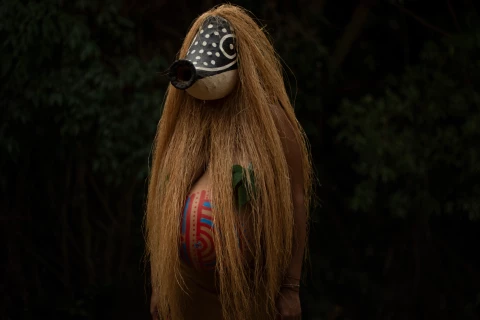
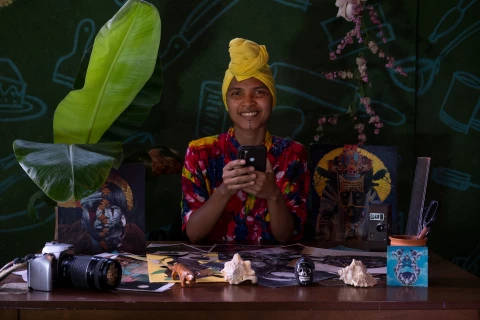
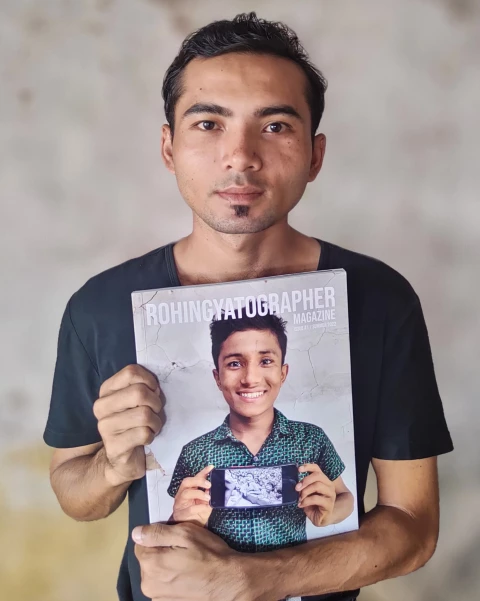
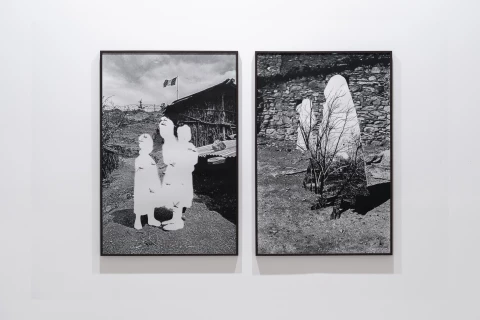
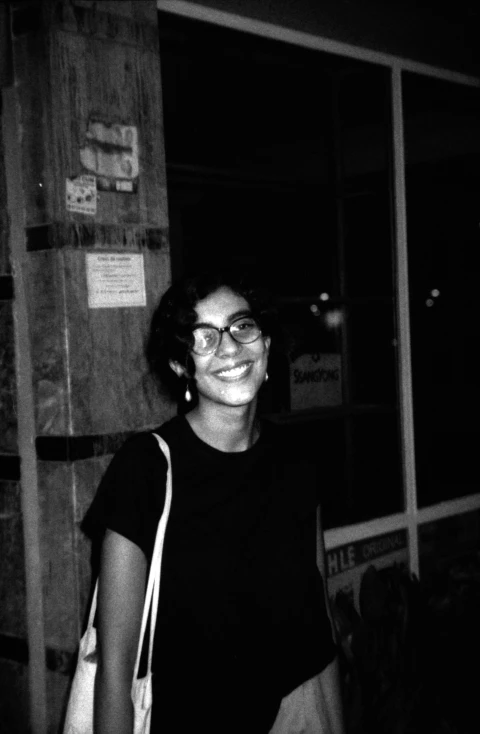
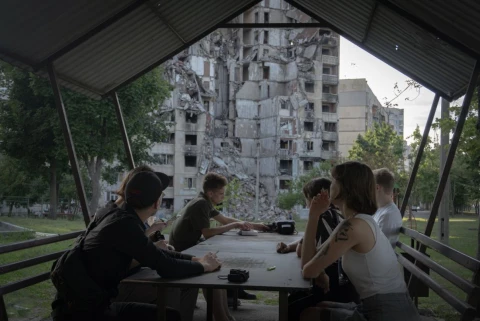
All images courtesy of Catalina Reyes Navarro, taken throughout the 10-day programme of studio days, panel talk and public art showcase.

Los Angles: What does it mean to work in contemporary art as a trans creative? Is it about resilience, resistance, or something else?
Lucrezia: For me, it feels like coming out of a cocoon. Especially coming from Georgia, being queer is a huge step and very political. It can be dangerous. But at the same time, it makes me stronger. The more I express myself, the more I believe in my art. It’s not just about creating something beautiful—it’s about saying: I can fight, I can show you who I am. It’s an act of courage, especially when you come from places where even existing is forbidden.
Princesa Hardcore: For me, it’s really about communication and understanding. A lot of the time, people don’t know how to interact with us—they don’t have the language or the awareness. So instead of immediately reacting defensively, I try to approach it as an opportunity to educate, to create dialogue. At the same time, my work is deeply connected to survival. It’s not something I do as a hobby—it’s something I rely on. Creating is how I process the world, how I sustain myself, how I keep moving forward. So it’s both practical and emotional—it’s survival, but also expression.


Okyanus: Being able to make art as a trans person is already a privilege. When you come out, you often lose the ability to hide—you have to confront your family, your surroundings, and the systems around you. Many people are rejected and forced to leave their homes. I’ve experienced this myself. I had to create distance from my family in order to survive. And even then, survival is not guaranteed—it becomes more difficult over time. So, continuing to create, to exist as an artist, requires constant resistance. It’s not just about making work—it’s about sustaining yourself in a system that is not built for you.
And how do these urgencies shape your work?
Princesa Hardcore:
Urgency shapes everything for me, because fashion isn’t a hobby—it’s survival.
I can create anywhere, anytime, and it’s always on my mind, every moment of every day. Sometimes I don’t even know what else to talk about, because I’m so consumed by it. It becomes a way of both escaping what’s around me and understanding it at the same time—I don’t just see it, I feel it. In the end, it’s all about survival.

How do you navigate being invited into spaces but also being tokenised?
Lucrezia: At first, I liked it—it felt exciting. But over time, it became harder. You start asking: when will I just be part of the group, without labels? Sometimes I was booked because I was “different,” like something exotic. People looked at me, but didn’t understand what I was trying to say. That’s very difficult.
Okyanus: Representation is important, especially in places where it barely exists. But often, it’s fragile—it depends on collaboration and support. In my context, many cultural spaces have closed, and many artists have had to leave the country. So even when representation exists, it can disappear very quickly.
What structural changes are needed to support trans artists?
Princesa Hardcore: One important thing is removing age limits in funding and residencies. Many trans people begin their artistic journeys later in life because of social, economic, or health barriers. So, when there are strict age limits, it excludes a lot of people who are just starting to find their path.


Val (Los Angles co-founder): Let’s move to a very hot topic right now: visibility.
When I started transitioning, seeing other trans people was incredibly inspiring and pushed me to create and be more open about myself. But over time, I’ve started to question visibility—it can feel like a trap, where we reveal so much that it becomes something others can use against us. Even though trans people are more visible now, on magazine covers and in media, it doesn’t always feel like real progress. I wonder whether visibility is truly empowering, or if it can also function as a form of control or surveillance—and whether there might be power in choosing not to be fully seen.
Lucrezia: Visibility takes a lot of courage. For me, at the beginning, it was difficult because I wasn’t fully comfortable with myself yet. There’s a psychological process you go through. But I do believe visibility is important. It helps people understand that we are just human beings—it normalizes our existence. And it gives courage to younger generations. So even though it’s difficult, I think we need more of it.
Okyanus: Visibility also brings expectations.
As a trans artist, you are expected to produce more, to represent more, to carry more weight. It also affects your safety. Being visible means being exposed.
So, it requires bravery, but it also comes with consequences.
Princesa Hardcore: For me, visibility becomes problematic when it starts affecting my process. When I feel like I’m creating for others instead of for myself, when I feel watched instead of seen—that’s when it becomes surveillance. So I try to protect my process and stay connected to my own intentions.


And how has the Seed Award impacted you?
Princesa Hardcore: It completely changed my life. It gave me the possibility to move to a new country and start again in a safer and more stable environment. It allowed me to create not just for survival, but also with intention and care.
Lucrezia: It changed everything for me. Before, I felt lost and stuck. I had ideas and skills, but no opportunities.
The Award gave me resources, but more importantly, it gave me confidence. It made me feel seen and validated. It made me believe that I could actually build something with my art.
Okyanus: I applied at a very difficult time in my life, when I was close to giving up. The Award allowed me to continue my practice and realize a project that I had been developing for many years. It was not just support—it was a turning point. I applied at a very difficult moment in my life. The award helped me continue and realize a long-term project I had been building for years.

Tell us how this week of Exchange has been for you so far?
Lucrezia: This week has been incredibly meaningful. I’ve never felt so welcomed before—it really felt like being with family. The connections we made, the conversations, the collaborations—it all felt very genuine and supportive. I also learned a lot from working with others, and I feel like these relationships will continue beyond this programme.
Okyanus: Collaboration is already central to my practice, so this process felt very natural. It was a very fruitful and emotionally rich experience, and it allowed me to expand my work in new ways.
Audience member: You spoke about education earlier, so I’m wondering—what advice would you give to people like me, or to organizations like the Prince Claus Fund, on how to better engage with and support trans artists? Especially when it comes to education—how can we actually do things better?
Okyanus: From my perspective, one thing that has become very clear—also through this past week—is that support cannot only focus on short-term production. Of course, it’s valuable to fund projects and exhibitions, but what is often missing is long-term engagement.
In many European contexts, institutions can be very nurturing in the short term—they provide space, resources, visibility—but then the relationship ends.
What would be more meaningful is sustained collaboration, where artists are supported over longer periods of time.
That kind of continuity allows for deeper development, both artistically and personally. It creates stability, which is something many trans artists don’t have.


Audience member: I want to build on that. There is more visibility now—trans people are on magazine covers, in media—but often it feels very surface-level. There’s not always much depth or content behind it.So how do we move beyond just visibility? How do we create more meaningful, content-driven representation instead of just presenting someone as “a trans person”?
Lucrezia: I do think it’s partly our responsibility, but not only ours. One important thing is creating more platforms—more spaces like this one, more collectives like Los Angles—where trans artists can actually tell their stories in their own way. Right now, there are very few programs that truly center trans voices. This kind of support is still rare. If there were more initiatives specifically designed for us, it would allow for more nuanced storytelling, more visibility that actually has depth. Because it’s not just about being seen—it’s about being heard and understood. So yes, we need more structures that actively support trans artists in sharing their narratives.
Okyanus: For me, storytelling is deeply connected to autonomy. I believe that stories should be told by the people who live them.
It’s very important that the subject has control over how their story is represented.
That doesn’t always mean traditional storytelling—it can take many forms. It can be an exhibition, an installation, a visual language that communicates something without explicitly explaining it. But the key point is that the person whose story it is should have agency over it. In my own experience, as a trans woman coming from a context where womanhood itself is heavily controlled and questioned, this autonomy becomes even more important. I would not want my story to be told by someone who doesn’t share or understand that experience—especially not in a way that distorts or simplifies it.

Princesa Hardcore: This also makes me think about history. I once spoke to a trans woman who told me about trans histories in Mexico—about how, before colonization, trans and gender-diverse people were part of communities in very different ways.
Today, media often presents us as something new, like a trend, something recent. But that’s not true—we’ve always existed.
So, storytelling is also about reconnecting with those histories, showing that we are not new, that we belong, that we have always been part of society.


Alma (Los Angles co-founder): I also want to add something more practical. Sometimes we talk about inclusion as if it’s something abstract or complicated, but it’s actually very simple.
If you want to support trans people, give them jobs. Give them housing. Give them access to healthcare. Give them the basic conditions they need to live and work. You don’t have to overcomplicate it—just remove the barriers.
And also, I think expectations need to change. Trans people in the cultural sector are often expected to be exceptional, to constantly prove themselves. But I would like to see more space for ordinary trans artists—for people who are just doing their work, contributing in small ways, without having to be extraordinary all the time.
We should be allowed to be average, to be normal, to just exist in the field without having to justify ourselves through excellence.
Maria (Los Angles co-founder): I also think it’s important to remember that trans people have more to say than just being trans. Very often, the narrative stops there—as if once you’ve shared your identity, the story is complete. But that’s not true.
We all have complex lives, different interests, different perspectives.
So, part of moving forward is allowing for more layered storytelling—stories that go beyond identity and reflect the full complexity of who we are. And that also connects to responsibility—what stories we choose to tell, and how we tell them, matters.
Audience member: I don’t know if this is a question exactly, but listening to all of you really shows how important these collaborations are—between institutions and grassroots collectives like Los Angles.
It also reminds me that culture is a basic need. And right now, funding for culture is under threat, even here.
Without financial support, artists can’t sustain themselves. I think there’s also a responsibility for all of us to protect funding for culture and education, because what you’re doing is truly meaningful and transformative.