A story by Nova Ruth SETYANINGTYAS
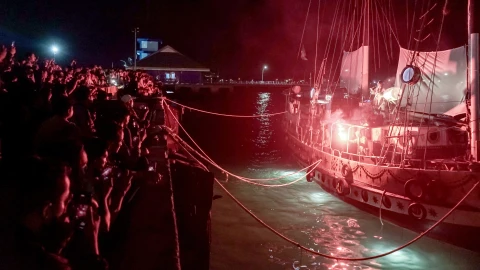
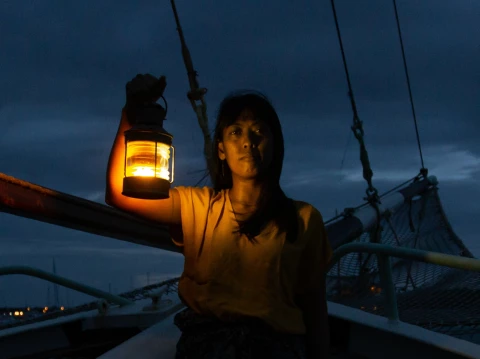
2023 CAREC Fellow Nova Ruth Setyaningtyas sails and performs atop Arka Kinari—a floating cultural platform that takes the form of a 70-ton sailing ship on a mission to foster resilience to climate change and reconnect people with the sea. Through experimental music, she carries environmental messages and stories gathered from coastal communities, inviting people to reconnect their relationship with nature and the living histories held within the ocean.
In conversation with Prince Claus Fund’s Communications Intern Dzikri Sabillah Anwar, Nova reflects on what it takes to care for the ocean in a time of climate crisis. From Indonesia's fading maritime identity and the ancestral memories carried by the sea to the role of art as a slow practice of listening, she shares how culture can offer new ways of imagining climate justice.

One of your missions with Arka Kinari voyage is to invite people to reconnect with the sea as a living archive of history, culture, and memory. What first drew you to Indonesiaʼs maritime heritage, and why do you feel these stories matter today?
My grandma was a Bugis woman, an ethnic group from South Sulawesi known for its long seafaring tradition. For her, the sea was almost like a second language, something that ran through her blood. Yet I grew up near volcanoes and didn't even know what a horizon looked like.
I know how to swim and have never drowned, but I always find myself asking: why do I feel traumatised by the sea? This unexplainable fear, which somehow feels ancestral, is what drew me to the ocean. When I stepped aboard Arka Kinari, I still couldn’t name the origin of that fear, but something in me shifted. The fear stayed, but I managed to slowly turn it into respect. As I spent more time at sea, I began to realise that the ocean holds memory. All waters eventually end up there before becoming clouds again. That was when I knew and truly felt that seawater is the archive.
I see the sea as a mother—loving and always listening, yet sometimes teaching you through tough love.
The sea also connects. Every port I arrive at reminds me that the sea has always been a meeting point for languages, rituals, and ways of living. I think we often see the ocean as a wall that separates us, when in fact it has always been a bridge. Once we understand that, we can see how communities are not isolated by distance but connected through currents, stories, and exchange.
Indonesia is the worldʼs largest archipelagic nation, but many people seem more connected to the land than the sea. How did we become disconnected from our maritime identity, and what role do colonial history or modern development play in that shift?
Yes, the sea has become strangely distant for many Indonesians. We experience it more as an idea than as something we're part of. To reach the sea, we're often told to become sailors, as if the point were simply movement. But access is rarely that romantic. Most routes are owned, chartered, and policed. If you want to be on the water, you usually enter through the doors of extractivism, freight, or tourism. Even the most “traditional” path—fishing—often sits inside the same economy of permission, quotas, and market demand. As a result, maritime life is often reduced to a vocation, a job description, or simply a means to an end.
Indonesia has lived through repeated attempts at cultural erasure—attempts we can name without even saying them out loud. Those histories didn’t just take language, rituals, and memory; they also thinned the threads that once tied people to land and responsibility. That matters now because the damage we’re witnessing is no longer only imported. Today, Indonesians ourselves also take part in the further destruction of nature, exploiting a collective amnesia that has never fully healed.
In the shadow of the Dutch colonial era, there’s a phrase we still recognise: Belanda masih jauh—“the Dutch are still far away.” Itʼs usually meant to reassure, to suggest there’s still time and space to prepare. But that comfort starts to unravel when the most aggressive extractors are no longer foreign.
What happens when the greedy capitalists are us? If the threat wears a familiar face, do we still have the luxury of pausing for even one short, deep breath before the next fight?


Many Indonesians grow up singing “Nenek Moyangku”, a childrenʼs song about seafaring ancestors, yet for many, the countryʼs rich maritime history—from Bugis seafaring traditions to kingdoms like Majapahit and Srivijaya—can feel distant or even mythical. How do you think art and storytelling, like what you do, can help “bring” these histories back?
It starts with taking time. Thereʼs something poetic about a project that moves this slowly. For five years Iʼve been returning to coastal communities across Indonesia. People share stories about their histories, myths, and half-remembered lineages. No two versions are ever the same, but there’s always a connection.
When I began to recognise ancestral trauma, I also began to feel an older web beneath it: the sailing routes that once stitched these shores together. And with that came another realisation—that we carry ancestral memory.
Some days it arrives as déjà vu. I’ll be sitting with elders under a tree, listening more than I speak, and something in me insists: youʼve been here before, you know this rhythm.

Iʼm not interested in romanticising the past. Iʼm more interested in what we can carry forward, such as ancestral values, room for difference, and the small beauties that survive across cultures.
Your performances weave together music, storytelling, and experiences gathered through your travels. How do you translate the lived experiences of coastal or indigenous communities that you encountered into artistic work?
The more time I spend with the coastal and mountain communities who carry their knowledge with such steadiness, the more my understanding of art changes. I no longer see it as something lifted onto an altar. It feels much closer to the ground and to the body.
To me, art is process and patience. It’s the quiet, sustained attention that lets difference become a gift.
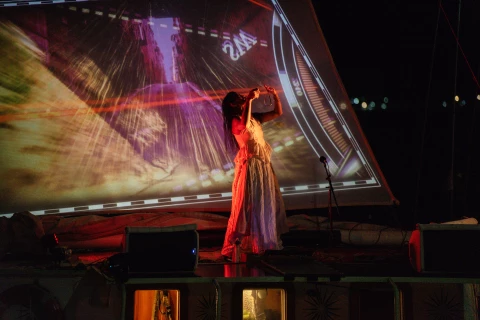
It lives in the way cultural perspectives and languages meet, sometimes awkwardly at first, sometimes with surprising ease, and in the way each person holds the meaning of time differently. Art can be beautiful simply because it’s created together and then allowed to be woven into everyday life until it becomes inseparable from living. In that sense, maintaining relationships between communities is also a profound work of art. This understanding isnʼt an excuse to be lazy in making art. If anything, it asks for more discipline.
It is a slow kind of mapping, like the way our ancestors once mapped through long, generational research. It accepts that imperfection and failure will always be present, and it keeps moving anyway. Within all of it, the ultimate purpose is to learn, again and again, how to be one with nature.

Many coastal communities have long practised ways of living with the sea, from customary systems to everyday knowledge passed down across generations. What have these communities taught you about caring for the ocean?
Caring for the ocean should be daily practices that become part of small decisions, rather than reserved for special or ceremonial occasions. And just as we speak of letting ecosystems recover, we also need to practice the courage of rest. For those who make art out of love for nature, rest can feel like betrayal because the urgency is real. At one point, the work starts to come from exhaustion rather than attention.
I find rest isn’t the opposite of care, rather, itʼs one of its conditions. Only when I slow down can I hear what is actually driving me, including the questions I avoid when Iʼm busy. Am I angry? Where is this pain coming from? What, exactly, am I grieving?
In that stillness, the task becomes clearer—not to erase the feeling, but to hold it long enough to change shape. To turn anger into precision. To turn pain into something that can be looked at without breaking. To transform what hurts into beauty without pretending it didnʼt hurt.
To make room for recovery is an ocean care, so that both the sea and the people who love it can continue.
If the ocean deserves to rest, then so do we. And if we want our work to help the world thrive, we have to learn how to thrive inside our own bodies first.
Your performances are deeply immersive, inviting people to listen and imagine different relationships with the sea and the earth. What kinds of conversations or actions do you hope audiences carry with them after experiencing your work?
Iʼm singing natureʼs grief.
I want them to understand that the goosebumps they experienced are a message. When I sing, something older than words wakes up in the body. People tell themselves itʼs just a beautiful voice, just a melody, just emotion—but itʼs more intimate than that. Itʼs the ancestors leaning in. Itʼs the ones who lived close enough to earth to recognise a warning, a lullaby, a prayer, a funeral song.
Sometimes they donʼt know it while itʼs happening. Theyʼre sitting in the dark, trying to follow the story with their mind, and the mind canʼt keep up. The language might be unfamiliar. The meaning might feel just out of reach, but the body knows and remembers.
And then, after the show, they come to me. “Why did I get goosebumps when you sang?”, “Why did I cry?”, “I donʼt even understand what youʼre saying.”
Understanding doesnʼt always arrive as a definition. Sometimes it arrives as a shiver, tears, or a feeling you canʼt justify. That is exactly how the ancestors speak. Theyʼre asking you to listen with the part of yourself that existed before you learned to be sceptical.


How has the CAREC mentorship programme supported you in sharpening your artistic practice?
CAREC taught me what it really means to slow down. In todayʼs fast, modern world, we rarely give ourselves time to pause and reflect. With CAREC, I could do exactly that.
The experience feels like sailing. You arenʼt pushed to constantly produce, to prove youʼre making something all the time. Instead, you move at a steady pace: slowing down, checking the course, fixing the mistakes with patience, rechecking again, and staying connected—always aware that youʼre heading toward the same destination.
For me, this goes beyond resilience in the era of climate change. It is a way of being with nature, moving with its rhythms, and remembering that we are part of it.
During the CAREC programme, what shared struggles did you and fellow artists or cultural practitioners face in raising awareness about the climate crisis?
We realised the Amazon needs Saharan dust to thrive, yet itʼs hard to hold in mind how easily that lifeline can be interrupted. As the Atlantic Ocean warms, the dust that once travelled across the ocean falls too soon into the water, unable to reach the forest. What looks like a distant exchange between desert, sea, and rainforest becomes a fragile route altered by rising temperatures.
Through this programme, weʼre trying to find ways not to be disconnected by the climate crisis—starting with something as simple as WhatsApp messaging, and growing into collaborations with the cohorts. The point isnʼt that messaging can replace the dustʼs journey, but that it can keep relationships and attention moving when larger systems falter. Itʼs a practice of staying in contact, of refusing to let distance become disappearance.


How do you think grants like CAREC can contribute to inspiring collective action around the climate emergency?
Grants like CAREC buy freedom and time to stop rushing, to listen properly, and to think through what it might take for us to survive together.
It’s rare. When a grant is narrow, inflexible, and buried under paperwork, it starts to work against its own purpose. Care turns into compliance. Learning turns into reporting.
Thatʼs why a programme like this needs a particular kind of team: not just programmers, but ecosystem builders too—people who can hold relationships, make introductions, and keep trust alive so that the connections between artists can endure beyond the programme itself.
Because collective action doesnʼt run on inspiration alone. It needs steady communication, shared visions, and room to do the slow work of staying aligned.


People in the Global South are often among those most affected by the climate crisis. What perspectives do you think Global South artists can bring to the global conversation on climate justice?
As an equatorial artist, I want to shift away from a perspective that treats us as victims. Yes—we are all affected by the climate crisis—but we cannot remain trapped inside it for too long.
Instead, equatorial artists can return to ancestral wisdoms with care. It’s a living source of values and ways of knowing. If we place those values at the core of our artistic practice, they can carry proposals, strategies, and forms of repair. In that sense, our work does not have to only testify to climate catastrophe.
It can also insist on climate justice by drawing from the solutions already held in our communities, our histories, and our relationships to land, water, and one another.
Images courtesy of Hibatul Hakim, Kitapoleng, Pierre Azevedo, Wendell Teodoro, and Gevi Noviyanti.