A story by Lady DONLI
In a candid conversation with writer Lanre, Nigerian multidisciplinary artist Lady Donli, a 2024 Prince Claus Seed Awardee, reflects on her identity, vision, and purpose. Calling herself a “Pan-African rockstar”, Donli uses music, research, and curation to spotlight the African continent and challenge colonial legacies that fragment its identity. She traces her Pan-Africanism to personal heritage and lived experience, blending continental sounds to spark curiosity and connection. Speaking openly about the structural and gendered obstacles for creatives in Nigeria, she highlights her feminist activism, including founding the Yar’Uwa Sisterhood to support women in the arts. Her work combines resilience, pragmatism, and visionary thinking, from dreaming of functional African infrastructure to building sustainable pipelines for women behind the stage, embodying an active, lived Pan-Africanism.
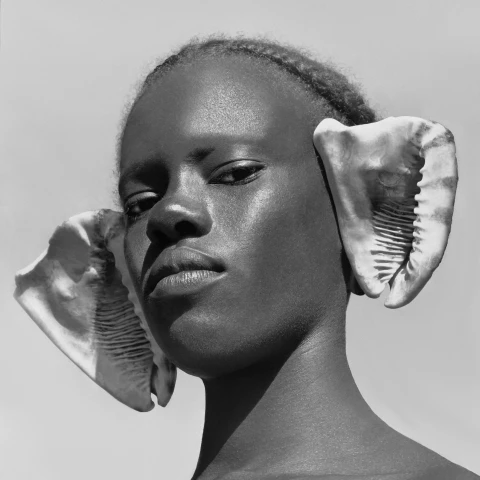
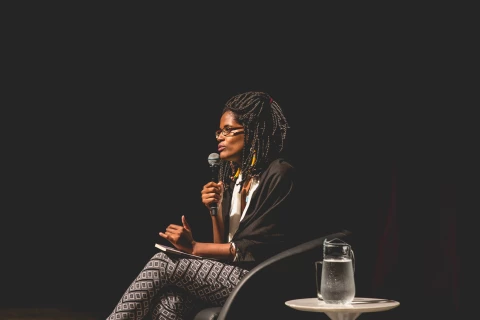
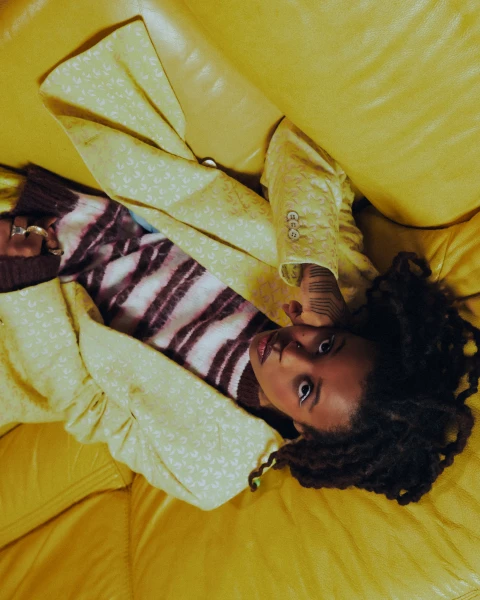
Her hair is in knots, she looks fresh-faced and unbothered, but with a smile on her face. Here, I am staring, albeit through my camera lens into the eyes of the self-proclaimed “Pan-African rockstar.”
This is Lady Donli: a multidisciplinary Nigerian artist and 2024 Seed Awardee whose work spans music, research, and curation. On the other side of the camera lens is me, Lanre, a writer and cultural accessibility researcher who shares her Nigerian heritage. The conversation starts with her describing her practice as grounded in a singular purpose. In her own words:
Whether it be via my music, or it could be via other people’s music that I work with, or it could be via archiving, or it could be, you know, via storytelling, but my main goal as an artist and as a creator is to spotlight the African continent in some way.
This ambition to spotlight the African continent, and the notion of a Pan-African rockstar reveals itself not as a branding choice, but as a deliberate political claim. “I think being a Pan-African rock star is always giving credit to where the inspiration comes from,” she explains, a deliberate stance against a time when “being African wasn’t portrayed to be cool.” A goal of hers is offering others like her a language of cultural pride. For her, the title can almost be seen as some form of provocation, or even a portal inviting people to ask what it means, so she can respond with a story about a certain belonging that stretches beyond nationality and interrogates the very colonial borders carved onto the continent. This identity of hers is a political and cultural statement that actively redraws the map of the African continent, and it pushes beyond the borders imposed by European colonisers. She embodies this philosophy personally, identifying as both Hausa and Ijaw, two of the many Nigerian tribes, and even jokingly referring to herself as a “Pan-Nigerian”, before scaling it to a continental pride, to be loud about where she comes from, to be proud about it, and, unafraid to take up space.

At this point, I am a bit curious, but mostly I feel it would be appropriate to help the reader understand what it means to be Pan African? Here, she breaks into a slight chuckle, almost a laugh even... And starts out reciting a Marcus Garvey quote,
“A people without knowledge of their past history, origin and culture is like a tree without roots”.
For her, this philosophy translates to an all-encompassing identity that supersedes the arbitrary borders of nations. She illustrates this with her own family’s history, tracing her roots to present day Chad before her great grandfather acclimatised in Nigeria, a personal story that highlights the continent’s deep, intertwined connections. This perspective is re-affirmed in her daily life, where she finds linguistic and often melodic similarities across the continent from Ivorian rhythms to Ghanaian high-life and Congolese guitar; all revealing the artificiality of colonial divisions. For her, Pan-Africanism is this lived reality, a conscious choice to see the fickle nature of these borders and to champion a unified, rooted, and representative African continent above all else.


So, what is the role of music in this Pan-African vision? For Donli, as she preferred to be called, it is the essential thread that weaves the ideology into a lived experience. She deliberately blends sounds from across the continent to function as a gateway, that is designed ‘not’ to lecture, but to spark a chain reaction of curiosity. A listener might hear a familiar pattern and be sent on a quest, searching for the Ivorian artist from whomst it originated, which might then lead them to explore Ivorian cuisine, and ultimately, to a conversation with someone from that culture where they discover shared similarities. And, her music as a starting point, a deliberate catalyst meant to dissolve borders by encouraging people to “think a bit more deeply”, transforming the abstract Pan-Africanism into a tangible, personal journey of connection and or discovery that allows people to dig beneath the surface of the music.
I proceed to ask her to dream up a theoretical Pan-African future for either the continent or even Nigeria as a country. She starts out with a disclaimer, promising to disappoint me with her response. We both chuckle here, I have an inclination of the direction she is heading to with her next words. There would be no visions of flying cars or abstract utopias. Her dream, forged and firmly situated in the daily grind of Lagos, is profoundly simple: “I just want a functional country.” She paints a picture of a foundational paradise: roads without potholes, reliable healthcare, constant electricity, and accessible internet; where productivity and learning aren’t luxuries. This vision immediately expands from Nigeria to the entire continent, noting that the story of infrastructural failure is a tragically unifying African narrative. “I want an Africa that works,” she states, where the ability to meet basic human needs isn’t determined by one’s status. For an artist whose entire ethos is about celebrating and touring Africa, this dream is the ultimate enabler. The freedom she truly seeks is the ability to build a life and a career entirely on her own terms, and, on her own continent.

We delve into what these challenges mean for her as an artist, for her creativity. The answer is a sobering lesson in some very practical logistics. Her Pan-African vision is perpetually hampered by a need for external validation and capital. “I can’t sustain myself in Nigeria, or on the African continent alone... I have to go to other spaces and look for funding,” she states, revealing that even our conversation is facilitated by a foreign grant. This relentless outward search stunts her growth, a stark contrast to the organic ecosystems she observes for artists abroad where, the ladder of progression is clear: small venues lead to larger ones. In Nigeria, she explains, a performer must be their own entire production company, scouting the space, building the stage, and sourcing sound and light, all with unreliable equipment. This DIY reality doesn’t just strain resources; it corrodes the very confidence required to dream big. Her conclusion is devastatingly simple: “Nigeria is a place where dreams come to die.” At this point in our conversation, we sigh. It takes us a minute to gain some re-composure to continue the interview, a certain sense of despair fills me, and a somewhat overwhelming sadness.
However, my curiosity is piqued about how she navigates all of these compounding issues particularly as a woman in the industry. She meets the question with a weary clarity. “Nigeria can be a misogynistic place, but not unlike anywhere else in the world to be honest”, she states, explaining that the struggle is especially acute for a woman with a world-view of what life could be. Her strategy is one of unwavering principle and community. Navigating it, for her, means being “really strong in my politics, you know, my feminist politics,” and channelling that into tangible action. This isn’t just about personal survival; it’s about building a new ecosystem. She has founded a community called the “Yar’Uwa sisterhood,” a safe space that offers workshops and advice for creative women, a kind of concrete effort to create the support system the industry lacks. Her mantra is to block out the noise and focus on her vision of a more equitable music scene in Nigeria, and the continent at large.
Her vision is defiantly collective. “I don’t care to be the first woman to do anything,” she explains, rejecting the lonely pinnacle of being a symbolic “first.” Instead, her goal is to create a “revolving door” of opportunity, ensuring that when one woman enters a space, she holds it open for others. This philosophy demands action, leading her to ask uncomfortable questions, as she did when finding herself as the only woman in a campaign photo-shoot and challenging the organisers’ patronising label of “strong.” Such insistence often leads to her being perceived as a “diva” or a “bad guy”. Labels she has learned to embrace, understanding them simply as the price for being a woman who advocates for herself and others.
This steadfast commitment to her politics inevitably invites blowback, but she meets it with a kind of serene defiance. When asked if she is afraid of pushbacks, she responds:
You see that I fought for a cause, I fought for marginalised people, and that’s all that matters to me.
She traces this conviction to a journey that began when she first identified as a feminist at 17, despite her initial fear of the label. Now, over a decade later, that fear has transformed into a source of strength. This sentiment is the very embodiment of resilience. When I ask her to define what that word “resilience” truly means for her as an African creative, the question prompts a knowing chuckle from us both. Our chuckling is absurd in the context of such a heavy topic, yet perhaps that is the point. For Donli, resilience is not an abstract virtue but a daily, grinding necessity. “The reason I’m consistently saying resilience is because we are given so little,” she explains, describing the compounded barriers of being a woman in Nigeria and a Black woman abroad as “blocks on blocks on blocks on blocks.”.


Her resilience, therefore, is this conscious focus on a distant horizon; spreading Pan-Africanism through music and creating that “revolving door” for women. It is what allows her to endure the constant fight for visibility and against being forgotten. “Every day you’re just fighting for something,” she says, framing it as an active, daily struggle to not only secure her own place but to carve out a space so visible it becomes a beacon, ensuring her story becomes a roadmap for others.
The conversation turns to her recent recognition as a Prince Claus Seed Awardee. When asked what the award means for her art, she dons a pageant-winner’s smile, describing it as a “vital framework for dreaming.” For an artist working in an environment that often stifles dreams, this was transformative. “It felt like someone had taken their foot off my head,” she says, the relief palpable in her voice. That breath of air allowed her to move from ideation to action, specifically to launch the women’s program, the Yar’Uwa Sisterhood, which she had long envisioned but lacked the resources to start.
This financial support has become a channel for exploring the fuller spectrum of her creativity. It allowed her to begin work on her first-ever sound installation, a product of the research her archiving mind loves. More than just funding a project, it empowered a purpose of extending her creative practice beyond personal gain to actively empower her community. The fund also provided an unexpected bonus: an extended community. Through it, she connected with fellow Prince Claus Award recipients who have since become both collaborators and friends, proving that the Award’s value wasn’t just monetary, but also about building a network of allies for the long haul.

I want to probe a bit more, curious to know what hid behind this pageant answer, asking for a more critical, perhaps even a de-colonial perspective. At this point, we go off the record and decide to keep it at that. However, as a skillful negotiator that I am, I manage to negotiate some details on the record. She articulates the central dilemma with a clear-eyed precision. She acknowledges the exploitative potential of these systems, noting how some foreign entities are “extractive without adding much value to the local ecosystem.” Yet, she immediately pivots to a haunting, open-ended question: if you take away these funds, “where does that leave a lot of African creatives?” For an artist trying to do meaningful research or build a sustainable career, the options are vanishingly few. With local infrastructure and independent labels struggling, her conclusion was a sobering piece of pragmatism. For now, she sees external funding as somewhat necessary, if imperfect, a means to an end; the essential ability to “bring back more into the country and continent.”
As we are now rounding up the interview, I proceed to ask her to dream; if she could get an even bigger fund, how would she channel those resources? The answer is immediate and precise, a vision that stretches from her community to the continent. She spoke of transforming her safe space for women (Yar’Uwa sisterhood) into a full-fledged residency program, building a pan-African network where creative women could connect and explore their art with unwavering support. But her dream drills down to a specific, critical deficit; the lack of women behind the stage.
We don’t have light technicians that are women. We don’t have a lot of stage designers that are women. We don’t have a lot of sound engineers.
Her goal isn’t just a one-off workshop, but years of sustained mentorship and access, creating a system where a female performer can finally work with a female technician who intuitively understands her vision. It is a dream of profound, structural change, one where the backstage crew finally reflects the woman on the stage.
Her hair still in knots, her face still fresh and with that same unbothered smile, she thanks me. Altogether, I leave our conversation feeling like, these indeed are the markings of a true Pan-African rockstar.