23 September 2025
Shade is a waste materials library that intersects youth, the arts and community practices. The collection is housed at an old converted corner shop grocer in Brixton, Johannesburg. This ever evolving hoard of pieces take on new forms, tales and mutations. An orphanage of objects where hundreds of micro-narratives serve as little windows into past lives, reflections upon the people that throw them out, those that collect them and then those that transform them. The objects form the basis of much of the work and community engagement that comes from the space, prompted by these very thrown-aways. Shelves adorned with tiny voices, echoing their chronicles and whispering their potentials.


Across the global south, waste reclaimers (known in South Africa as the bagarezi) collect waste materials from homes and businesses, separate these recyclables and sell them to buy-back centres. Earnings fluctuate due to incoherent oil prices, industry and global economic yo-yoing. The bagarezi are responsible for nearly 80% of the country’s recycling rate, yet these peripheral purveyors are unseen/unsupported and incredible economic and environmental benefits are made off of their backs and livelihoods. Luyanda Hlastwayo, African Reclaimer Organisation’s (ARO) beacon and comrade termed the bagarezi as accidental environmental agents. These agents (predominantly Basotho ”undocumented” migrants) are quietly pushing trolleys of up to 100 kilograms, beyond 20 kilometres across the city in an attempt to earn a living, but at the same time contributing to far more than the meeting of eyes.
Majority of the materials at the library are sourced and bought from the bagarezi, mostly non-recyclables. Those filling Johannesburg’s already devastated water ways, crippled landfills and crowded city streets. These materials seem to hold no real value to them and society at large (hence their reason for being discarded).
What exists in daily life, exists in the waste stream (just ten fold).
The library has been a conduit for many conversations from passers by, artists, academics, youth and the larger community of Brixton and beyond. Like most of the projects that Shade has facilitated, they have all been in direct response to the community. In 2018, a few curious children began hanging out, making art and playing in the library and studio. To date 30+ children from the area attend a free weekly creative arts programme. The programme hosts guest artists, exhibitions, outings, community murals and outdoor artworks. Two off-shoots of the programme the youth-led Brixton Photo Collective and the Sentech Croozers (crew of youngsters from Brixton modifying street bikes and perform tricks).

Waste Not Want Not is an artist residency programme, where artists and crafters are invited to create works using the library and Shade’s studio space. Works for the 2021 iteration were shown on exhibition where upcoming artists, mid-career artists, youth, children and crafters were placed alongside one another in an interdisciplinary, intergenerational show that attempted to reflect upon the nature of waste and its potential.
In 2023, the following residency gave space to over 15 multidisciplinary artists to create new works to show at the annual Brixton Light Festival.
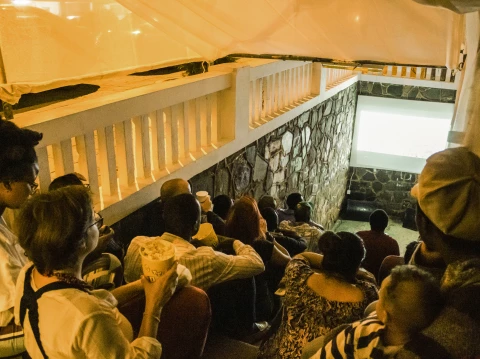
Shade curates this community-led DIY parade through Brixton that celebrates the suburbs rich cultural diversity through performance, art and music. The first festival started in 2020, as a response to the difficulties experienced by the community during the pandemic. The intention was to create an otherworldly space in which the community could safely gather at night by illuminating the streets and to celebrate all that makes Brixton vibrant. The 2023 Light Festival was months in the making, where micro-events and happenings were targeted at various demographics in the area such as youth, children, students, academics and migrant communities. These micro-events were to enable the mapping of Brixton - the people, the geography and its histories as well as a space to co-create the festival. This mapping was the foundation of the festivals’ curation and guided the facilitation of the projects within.

The theme of the watershed (which runs through the small suburb) led the narratives, connections and projects that were shown leading up to and at the festival itself. Johannesburg is one of the only large cities in the world with no natural water source, and the watershed became the political and social divide during the Apartheid years. The watershed theme gave way to many conversations and sub-themes such as water conservation and education, water mythologies, messages carried across waters and simply - where the water meets light.
As capitalism booms on with unrelentless vigour, consumerism breeds redundancy and sentiments of “out with the old”, as if out is a mere minor peripheral detail. Hand in hand, industries produce things with even shorter life spans. Although usages are short-lived, their existences become even more eternal - where hybrid components of almost unidentifiable polymers seep deep below the surface. Into the water, travelling great distances to serve as snacks to sea life and then to be consumed physically by the very human creatures that paid using limited resources for that new doll on a birthday, the designer suits for a farewell or for these picturesque moments of materialism on yet another upgraded iPhone. A circular, round trip of incongruence and ultimately - the collective consequence of a wasted earth come graveyard adorned with sobbing trash-filled mourners.
Their plastic tears will once again seep deep below the surface, where forgotten memories of clean worlds are drowned out by these toxic territories.
In this age of waste, economies can only exist through the trash they make. We are here now, and our waste is no longer invisible. Adaptation is essential to life on earth, as nature reflects.
The prototype of digitising this waste library perhaps can in future be a tool and a space of reflection to ignite new word-building and prompt more mico-actions within communities, where tomorrow’s ecology can be reimagined. Things may be burning but there are messages in the ash that can both fuel and quench the flames. We may be going in circles, but tail-eating loops infinitely as memories prompt revolutions.
Out with new, in with old.