04 August 2025
Environment / Climate emergency
“Radio-Activity to the Open Sky” project is part of my research about invisible ecologies. A term that has evolved over the years of my practice and work as an artist, professor and researcher. I like to imagine invisible ecologies as that synchrony of restless bodies that are the world, matter, energies and phenomena of life. Those that can happen from the orders of the microscopic and atomic to the planetary and beyond, but to be able to observe them requires the equation of thinking and feeling together. That is, how to know and how to feel. Where is the frontier between one and the other? Is there one? To feel the flavors of the land is to know its feelings.
To know how the earth feels and how it feels, is to know about ourselves. It is to taste ourselves, to smell ourselves, to listen to ourselves, to feel-thinking what it means to be Earthling.
This deep and intimate relationship of the bodies between and with the bodies, is painfully and exhaustedly emerging from the inheritance of a modern world system in crisis and that strives to violently split the relationships between subject-object, human-nature, culture-nature, and even between art and science. Thinking matter is not the same as inventing the image of the world, and the normalisation of these binarisms continues to motivate the construction of an incomplete feel-thinking of the world.

To think knowledge without divisions is to think of the weaving, the skin that connects us: it is to think of the environmental. In this sense, the tonification of an environmental thought of the south nourished from an aesthetic expanded by invisible ecologies allow us to conspire in the urgency of feel-thinking in telluric and geological tonality. A radical conspiracy in the face of an institutional, global, industrial and mercantile way of thinking about the environment as mere goods or resources in a finite world. Thus, going forward, this on-going project embraces a feel-thinking that asks how we can overcome modern dualisms, the meanings of separation and domineering actions, to poeticise the world and reconcile ourselves with life.
This artistic research aims to bring together a transdisciplinary and collaborative work group in partnership with different organisations, assemblies, institutions, activists, artists, and local agents. The project takes the form of a series of activations to denounce the radioactive contamination generated by the fracking industry and its oil waste. Situated in the region of Vaca Muerta, Argentina, which is currently one of the most important oil and gas reservoirs in the world, we try to open a collective and urgent debate about the possible harmful and toxic effects on communities and the environment due to the exploitation of unconventional hydrocarbons. We embrace environmental humanities, artivism, and the education, development, and communitarian use of emerging technologies for environmental monitoring as an opportunity to empower body-territories and their resistance efforts that challenge and expose how global fossil fuel metabolisms have led to the sacrificed lives in this region of Latin America.
Year after year, technologies expand the frontiers of human action together with an industrial agenda that perforates state power by global corporate, colonialist, and extractive economic interests.
The gas and oil exploitation is painfully expressed in a clear eco-social overreach threatening local bodies, desires, and subjectivities.
The myth of progress is the narrative that inoculates the common sense of modernity in these areas by the hand of a “technolatry,” which creates the illusion that contemporary technologies function in isolation, detached from social and ecological systems and are thus unburdened by eco-social responsibilities.
The design decisions of these extractivist technologies are a clear example of a design subject to ideological, economic, and political power relations with repercussions that threaten not only the welfare of communities, but also the sustainability of life itself. Thus, fracking can also be understood as a bio- and geo-technology that reorganises matter, bodies, and territories by embodying new economic, cultural, and political regimes. Therefore, this project suggests the concept of "geotechnology" as an umbrella term to capture the biological-cultural and geological-territorial violences committed by hegemonic “techno-diversities.”
However, having subversive and accessible tools and technologies opens up an opportunity to investigate local questions that do not have a place in a dominant legal and technoscientific agenda. Emerging technologies can be targeted to offer alternatives and different forms of intervention by publicly supporting acts of resistance and community-based eco-social and political activism.
Throughout this research we have embraced questions about how art –– understood as a tactical tool –– can aid the construction of a dignified territorial and energy sovereignty for human, nonhuman communities, and the commons, and how collaboration between undisciplined practices in the arts, sciences, and technology can generate evidence that strengthens local causes, movements, and resistances.
Fracking and radioactivity
Since 2011, the energy debate in Argentina has maintained one consistent line of thought: the expectation that unconventional hydrocarbons should continue to be developed in Vaca Muerta, a sedimentary formation deposited in a Jurassic-age sea in the Neuquén Basin. According to the US Energy Information Administration, Vaca Muerta is one of the most important shale oil and gas reservoirs in the world.
Fracking (or hydraulic fracturing or stimulation, as the semantics change to sweeten the ear) is not new in the industry. What is new is the extent and number of territories and communities that are being exposed to the treatment, contamination, accidents, waste, and eco-social injustices caused by this industry. Currently there are a series of territorial disputes around this geological formation between oil companies, Mapuche Indigenous communities, horticulturists, farmers, neighbours and different levels of the state. An overview of the territorial conflict, state, and para-state violences, and the processes of tension and negotiation between the different actors in conflict make it clear that violence in the territory is complex and multidimensional in nature.

The accelerated growth of this industry could be represented by the amount of shale-type oil extractions from the Vaca Muerta areas per day. By the end of October 2022, they exceeded 250,000 barrels per day. This amount is enough to cover the needs of the national refineries, without the need to import it. This phenomenal growth is the counterpart to the sharp drop in the production of conventional oil extraction sectors. However, hand in hand with the boom of this industry, there are also the acts of silencing in the form of monetary compensation, the migration of local populations due to the acquisition of properties affected by spills and contamination, the concealment of intoxication and loss of water sources and farmlands, the fall and dizzying rise of the real estate system surrounding the industry, the increase of seismic activity due to drilling, and the destruction of health and quality of life in these areas. Although the problem of fracking in Vaca Muerta is mainly focused on its production and the consequences it entails for the international market, fracking in our communities is also synonymous with toxicity and damage to the health of ecosystems and their inhabitants in the short and long term.
The management of waste and environmental liabilities from fracking is one of the most problematic issues in Vaca Muerta. The high intensity of exploitation inherent to fracking also goes hand in hand with high volumes of wastes that under Argentine law must be treated as "hazardous.” According to national legislation, the companies operating hydrocarbon areas are responsible for the hazardous waste they generate. However, its management and remediation have shown great administrative and infrastructural failures in the sector.
“Oil waste” refers mainly to cutting or drilling muds, flowblack, or return water from fracking and the so-called tank bottoms, among other wastes, considering that a single hydraulic fracturing well requires the use of several thousand to millions of litres of water, around 450 to 2,300 metric tonnes of sand and several tens of chemicals, many of them toxic. In addition to containing the chemicals used throughout the drilling and fracking process, these wastes usually bring to the surface quantities of substances stored underground, such as heavy metals –– mercury, chromium, lead, cadmium, arsenic, etc. –– and also natural radioactive materials such as uranium, thorium, radium, and radon. After almost a decade of activities, about 400,000 m3 of drilling mud was produced in more than 2,000 wells drilled in Vaca Muerta.
During our research on radioactivity in residual oil sludge landfills, we have encountered responses from industry representatives and workers who refer to it as insignificant, but a literature review of scientific studies on the subject make clear that the amount of radioactivity we are facing here is certainly not comparable to the radiation emitted by the potassium in a banana or a granite countertop. The American Association of Radon Scientists and Technologists, together with other US researchers and collaborators, detected and estimated that radon gas is released into the environment during fracking operations based on measurements during different phases of the oil and gas drilling and extraction process in wells located in the Denver Basin, Colorado.4 Significant radon increases were found at the site during the separation and storage phases, where the radon in open air is ten times higher than the level outdoors. The Argentine Nuclear Regulatory Agency conducted studies on conventional hydrocarbon facilities confirming the presence of radiation and suggested the reduction of occupational exposure time.5 Although there are few scientific studies focused on the relationship between radiation and fracking, there is enough evidence to demand a corresponding institutional and scientific review to reformulate the management of oil drilling wastes as possible sources of radiation that put the health of communities and the environment at high risk.
Currently, in Argentina, there are complaints and legal actions underway focused on linking responsibilities for the contamination generated by toxic oil waste and practices, including two official waste management facilities with state support, Indarsa and Comarsa, for not carrying out "the corresponding treatments" for hazardous drilling wastes.6 However, to this day, these two companies have not yet complied with the obligations and deadlines issued by the provincial government according to Decree N°2263, enacted in response to the public questioning generated by the various complaints from neighbours and communities. These inactions only encompass an even bigger problem which is the functionality of Vaca Muerta itself and the state’s lack of action against decarbonisation measures and local and national environmental and health policies. From this framework, this project addresses in favour of local and communitarian actions and their battle for a dignified life, in the face of escalating climate change caused by the metabolisms of the technosphere.
Methodology
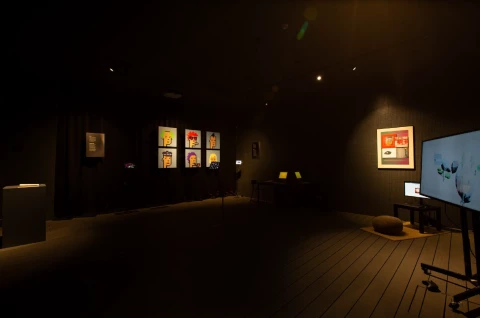
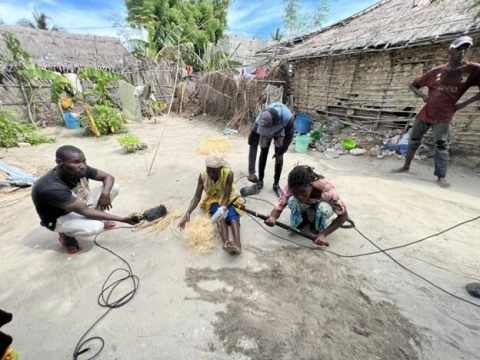
Through experimentation with various techniques and open-source tools, communitarian radio activism, and resources such as data collection, audiovisual materials, satellite images, photogrammetries, reports, newspaper articles, and testimonies, we seek to generate different pedagogical activations, publications, and digital models of visualisation and sonification of environmental data. Our aim is to present these materials in an accessible way to facilitate their inclusion in assemblies; legal, cultural, and civic forums; public events; and museums to demand responsibilities and mobilise this research in support of the communities and the protection of the commons.
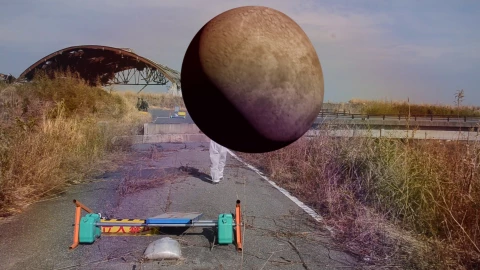
Initially, different fieldwork was carried out to generate a survey and map the radiation emitted by cutting deposits (oil muds) at official dumps in three key cities of the fracking industry in the Vaca Muerta region: Allen, Neuquén, and Añelo. For this purpose, an open-source hardware Geiger-Müller (G-M) counter was developed with an air quality monitoring sensor capable of detecting carbon monoxide and carbon dioxide levels, together with a digital platform for storing and analysing the measurements obtained. Several digital fabrication techniques were used in the development, such as electronic prototyping, 3D design and printing, and programming.
The G-M is an instrument for measuring the radioactivity of an object or place. It is a detector of particles as well as ionising radiation. These portable detectors are generally used for the measurement of radioactive contamination due to their low cost, robustness, and relatively high detection efficiency. Although other types of sensors and measurements must be used to discriminate more accurately between alpha and beta particles or to obtain information about the energy and power of the particles, this device is a first exploration to perceive directly, sonically, and visually those "invisible" physical agents –– toxic and pollutants –– that are exposed to the open air as a result of fracking and irregularities in the management of these hazardous wastes.

Capturing the voices of the radioactive matter in conjunction with the voices of animals, plants, rivers, valleys, and social movements allows us to see the present biopolitical condition: a grieving, homogenised landscape, and destructed refuges for alternative ecological communities. To date, there is no official national technical and scientific research document that addresses radiation in oil fracking waste and its effects on health and the environment. It is, therefore, with this device that we take first tactical action towards creating a fissure in the legitimacy of knowledge and to trigger the denunciation of radioactivity and the fracking industry, as well as linking different state, institutional, scientific, and technical actors in the face of this socio-environmental health problem. I believe that this project can contribute to inciting governmental institutions and the scientific community to investigate further into the radioactive emissions generated by fracking and its effects, and carry out the corresponding studies and calculations.
Bruno Latour, in his essay “To modernize or to ecologise? That’s the question”, writes that we must choose between “modernising and ecologising,”7 and we must do so with the awareness that each new shock in our understanding of science puts in tension the whole apparatus of modernisation. Clearly, the extraction of knowledge from the Earth is not directly proportional to the planet’s own time and space. Every day we build new instruments and develop more powerful techniques to dig deeper and deeper.
Thus, it is necessary to pay attention to the “deep time” of terrestrial metabolisms if we are to open a critical dialogue on how we construct and exercise our relationships with nature through technoscientific development.
Having the possibility of representing those materialities and phenomena that escape our human senses implies being able to reselect and emphasise certain aspects of reality and obviate others, to make distant phenomena plausible and measurable, and to determine who or what is represented, included, or marginalised. Each line of agency of the phenomena we can study with these devices has implications for where bodies, territories, and phenomena occupy and how they are differentiated, evaluated, and categorised. The power of these technologies is potentially devastating when they do not pay attention to their consequences, among them the construction of realities at the service of the dominant discourse, violence, or eco-social injustices. In this sense I'm convinced that the emergence of an artivism towards eco-social justice in a deep relationship with emerging technologies can be directed to offer active, collaborative, and participatory alternatives that nurture and strengthen other ways of planetary existence.