A story by Zakiyyah HAFFEJEE
Artistic mobility has become a defining condition of contemporary art labour. Artists are increasingly asked to “translate” and relocate their situated practices across geographies, institutions and audiences. What does it mean, within these structures of mobility, to carry a practice shaped by specific histories and places into other frameworks without flattening its nuances?
Based in South Africa, Zakiyyah Haffejee is an architect and researcher, and Moving Narratives Fellow. Her interdisciplinary work resists clear categorisation. Engaging with themes such as colonial afterlives, diasporic identity and spatial memory, she approaches them as layered and unresolved rather than problems to be clarified. As she notes, her aim is to hold space for complexity without turning her work into a didactic educational tool.
In conversation with Marianna Stefanitsi, whose research considers how artistic mobility intersects with questions of belonging, temporalities, solidarity and local engagement, Zakiyyah reflects on movement between art world centres and margins. She reflects on how vulnerability and discomfort can open up space for practices to be shared, exchanged and reimagined.
Could you tell us about your artistic practice and the main themes you are currently working with?
My practice sits between architecture, research, and artistic inquiry. I work with spatial narratives, mapping, and textiles as ways of thinking through questions of identity, memory, and belonging.
Much of my work emerges from the Global South, particularly South Africa, a place where space is never neutral and where histories of extraction, migration, displacement, and survival remain etched into the everyday.
I am interested in how bodies carry knowledge, how everyday practices shape space, and how marginalised histories can be reclaimed through material and spatial storytelling. Recently, I have been focusing on textiles as a spatial device, using them to explore hybrid identities, gendered labour, and spirituality as lived, embodied experiences.


How do you understand movement in relation to your artistic process and how does a situated artistic practice continue to exist when it relocates?
For me, movement is more than just changing locations; it is also about shifting ways of knowing.
My work is influenced by moving between places, fields, and cultures. When my practice relocates, it does not vanish—it adapts. It takes in new situations, challenges, and ideas. I see my practice as something I carry with me through my body, memories, and methods, not something tied to one place.
Moving to new places makes me think more about translation, responsibility, and care, especially when working across different regions.
What challenges do you encounter when presenting your work to audiences unfamiliar with the social or political issues it addresses?
One of the main challenges is resisting simplification. When audiences are unfamiliar with the contexts from which my work emerges, there is often a desire for quick explanations or greater legibility.
However, many of the issues I work with, such as colonial afterlives or diasporic identity, are layered and unresolved. I try to hold space for complexity without turning my work into an educational tool that flattens lived experience. There is also the challenge of emotional distance, in which pain or struggle can be experienced abstractly rather than as ongoing and relational.

How was your experience in Moving Narratives, Cycle 2, and what role do you think the Prince Claus Fund plays in supporting alternative or marginalised narratives?
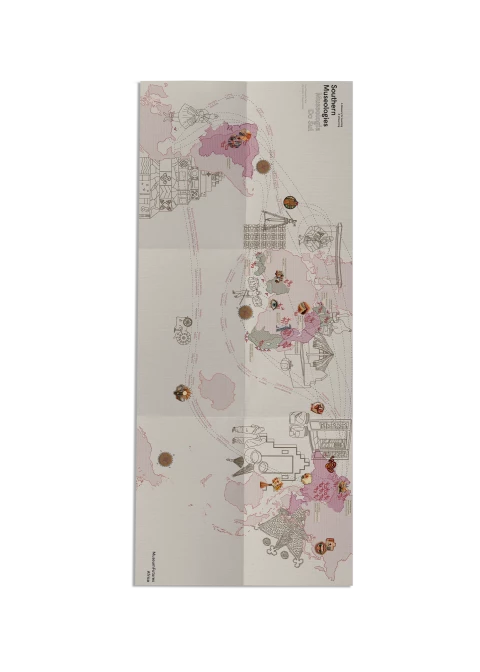
Moving Narratives felt generous and intentional. It created a space where slowness, listening, and care were valued over production or visibility. One particularly memorable activity was a collaborative workshop in which artists from diverse backgrounds came together to create a large map. This map, composed of individual pieces representing our narratives, grew as we shared stories and techniques. It exemplified the program's values of interconnectedness and creative dialogue, allowing us to witness the beauty of diverse cultural expressions merging into a work of art. The Prince Claus Fund plays an important role in supporting practices that do not easily fit dominant cultural frameworks, particularly those from the Global Majority.
Rather than asking artists to adapt their work to existing systems, the program allowed our narratives to remain complex, unfinished, and rooted in specific contexts.
What did it mean to work with artists and cultural practitioners from diverse cultural and geographical backgrounds, particularly through experiences in Lab Weeks in the Netherlands and Nepal?
Working alongside practitioners from different geographies made visible both shared struggles and deep differences. The Lab Weeks in the Netherlands and Nepal highlighted how context shapes not only artistic output, but also pace, access, and modes of care. Being in Nepal, in particular, shifted my understanding of land, spirituality, and collective knowledge.
These experiences challenged my assumptions and reminded me that learning often happens through discomfort, vulnerability, and exchange rather than consensus.

In what ways can moving through unfamiliar worlds together with others sharpen how we practice solidarity and deepen our understanding of others’ struggles?
Moving together creates accountability.
When we are outside our familiar frameworks, we are forced to rely on one another, to listen more closely, and to recognise our own blind spots. Solidarity becomes less about shared identity and more about shared responsibility. It asks us to sit with difference without trying to resolve it, and to understand struggle as something that is relational rather than comparable.
What do you consider the most valuable thing you gained from participating in Moving Narratives?
The most valuable thing I gained was a sense of permission: permission to work slowly, to remain rooted in my context, and to trust my intuition. Moving Narratives affirmed that my way of working, which often sits between disciplines and resists clear categorisation, has value. It also gave me a community of practitioners who continue to shape how I think, work, and move through the world.