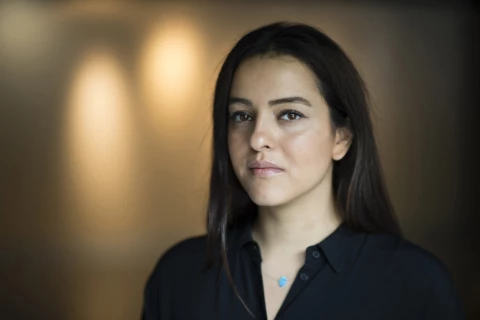
When And They Laughed at Me is opened, the latest book by photographer and 2015 Prince Claus Awardee Newsha Tavakolian, the first image is not immediately legible. A band of white-yellow light burns into red and then black: an exposed negative, or perhaps the beginning of an image before it has fully arrived. Turn the page, and Tavakolian’s archive begins to appear through contact sheets, fragments and her own handwriting. Beneath one of her earliest sheets, she writes: “My first contact sheet. I was sixteen and didn’t drop out of school to wear my sister’s jacket. (1995).” The sentence is intimate and slightly unruly, closer to a note recovered from a drawer than the authoritative caption of a photojournalist.
This is how the book asks to be read: not as a stable account of Iran, but as an encounter between the photographer and the person she was when she first made these images.


Tavakolian began working as a photojournalist in Tehran at sixteen. And They Laughed at Me returns to photographs made between 1995 and 2001, bringing them into conversation with work produced between 2017 and 2019. Contact sheets are reproduced whole, retaining crossed frames, light leaks and uncertain exposures. Among them is a portrait of a young woman smelling a red rose at an election rally. On spread 67, the photograph appears intact beside a handwritten note about politicians promising greater freedoms for young people. On spread 118, the same photograph returns torn into vertical pieces and held together with strips of grey tape. The woman’s face, the rose and her hands remain visible, but the breaks can no longer be removed. The image has not been restored to its original condition; its damage has become part of its meaning. Its two appearances hold different moments together: the political hope attached to the photograph when it was made and the anger and hindsight through which it is later encountered.
The book arrives while Iran is once again being made visible internationally through the language of war, threat and outside power. Against the demand that photographs explain the country—or furnish another political narrative about it—And They Laughed at Me insists on something less easily instrumentalised. Its Iran is carried through gestures, friendships, bodies, jokes, injuries and contradictory desires; through a young photographer’s belief in witnessing and an older artist’s doubt about what witnessing can accomplish. London-based (Bulgarian) Turkish visual researcher, programmer and organiser, Bayryam Bayryamali, sat down with Tavakolian and the two spoke about publishing these photographs in the present political moment, the responsibilities of making an intimate archive public, and the distance between preserving an image and attempting to repair it.
What has it meant to publish this intimate archive during the imperial war on Iran? Has this political moment changed your responsibility towards the images?
The book was never meant to be about war. It is about ordinary life in Iran between 1995 and 2001—about people growing up, falling in love, protesting, hoping, and simply existing. Yet it is being published at a moment when Iran is once again reduced to headlines about bombs, geopolitics, and military power. That coincidence has made the book feel even more urgent. It reminds us that a society cannot be understood through conflict alone.
The current political moment did not change the photographs themselves, but it deepened my sense of responsibility toward them. I felt an even greater obligation to protect their intimacy and complexity, and to resist allowing them to become illustrations of today's crisis. These images belong to people's lives, not to political narratives. If they offer anything now, it is the possibility of seeing Iranians as individuals with memories, contradictions, humor, grief, and dignity—not simply as subjects caught between states and wars.

What do you recognise in the photographer you were at sixteen, and how has your relationship to photography changed?
Looking back, I realised that at sixteen I was already drawn to the same things that still concern me today: people living through change, the tension between private life and public events, and the small gestures that reveal something larger about a society. I was very young, but I was already watching closely. There was urgency in the way I photographed then, and perhaps also a belief that photography could hold on to something before it disappeared.
My relationship to photography has changed because I no longer see the image as something neutral or complete. When I was younger, I believed more strongly in the decisive moment and in the power of witnessing.
Today, I am more aware of what an image leaves out, how it can fail, and how the photographer can also become implicated in what is being shown.
I work more slowly now, and I allow doubt, damage, and even destruction to become part of the work.
When does an intimate photograph become historical, and how did you avoid making these images explain Iran?
I never chose images because they could explain Iran to an outside audience. I chose them because they were honest moments between the people I photographed and me.
For me, an intimate photograph becomes historical not because it illustrates an event, but because it preserves the emotional atmosphere of a particular time. A gesture, a glance, a moment of waiting, or people dancing in a private room can say as much about a society as a photograph of a protest.
History is not only made in the streets; it is also made in living rooms, in silence, in relationships, and in the ways people find small spaces of freedom.
I was careful not to include images that reduced people to symbols of suffering or turned their vulnerability into proof for someone else's understanding of Iran. I wanted each person to remain an individual, with complexity and dignity. If the photographs carry historical meaning, I hope it is because they insist on the humanity of the people in them, rather than because they serve as evidence for a political narrative.

What can a “failed” photograph say about memory, history or truth that a perfect image cannot?
For many years I believed photography was about making the perfect image. Returning to my archive changed that. I realized that the damaged prints, torn photographs, contact sheets, and overexposed negatives often carried more emotional truth than the polished pictures. They reveal hesitation, time, loss, and the fact that memory is never complete.
A "failed" photograph acknowledges its own limitations. It doesn't pretend to be objective or final. Instead, it reminds us that every photograph is partial—that something always exists outside the frame.
As I grew older, I became less interested in perfection and more interested in honesty. These imperfect images allowed me to speak not only about what happened, but also about what has been forgotten, suppressed, or transformed over time.
What did handwriting allow you to do that a conventional caption could not?
For me handwriting carries the presence of the person who wrote it, it has hesitation, rhythm, and emotion. I wanted the reader to feel that these words were coming directly from my notebooks and my memories.
A conventional caption explains an image by giving facts: who, where, and when. I wasn't interested in explaining the photographs. I wanted to create another layer—one that could hold uncertainty, contradiction, and reflection. The handwriting makes the archive feel alive and unfinished. It reminds the reader that history is not only made of facts, but also of the way we remember them years later.


Where does the title And They Laughed at Me come from?
The title comes from the Iranian poet Bakhtash Abtin, who died in prison after being denied proper medical treatment during the COVID-19 pandemic. Before his death, he wrote a poem recalling the moment he entered prison. A guard asked him, "What is your occupation?" He answered, "Poet." The guard laughed at him.
That image stayed with me. It says something about the world we live in—that to be a poet, or to believe in art, imagination, and culture, can itself become something to be mocked.
What do you hope readers carry with them after closing the book?
For me, what was important was also to remind people in Iran how long the road has been to get where we are today. Every generation believes history begins with them, but it doesn't. So many women, men, children, and even animals have paid the price for the freedoms we continue to fight for. Their stories, sacrifices, and acts of resistance should not disappear.
This book is not only for an international audience; it is also for Iranians. It is a reminder of a country that too easily forgets its own past. I hope it encourages people to look back, to recognize those who came before them, and to understand that today's struggles are part of a much longer history.
Photography cannot change the past, but it can help us remember it before it is erased.

What should young photographers understand before learning how to make strong images?
Of course, you're asking me this question, and my answer comes from the fact that I have lived and worked in Iran all my life. If I had grown up somewhere else, my answer might have been different. I might have told young photographers to go out, be free, experiment, discover themselves, and enjoy the endless possibilities that photography offers.
But for me, having a camera in my hands has always had a different purpose. It was never just a creative tool. It became a way to witness, to remember, and sometimes simply to prove that something happened. It gave me a reason to be present, to ask questions, and to preserve moments that I knew could easily disappear.
So before learning how to make a strong photograph, I think young photographers should understand why they are making pictures in the first place.