A story by Gatari Surya KUSUMA
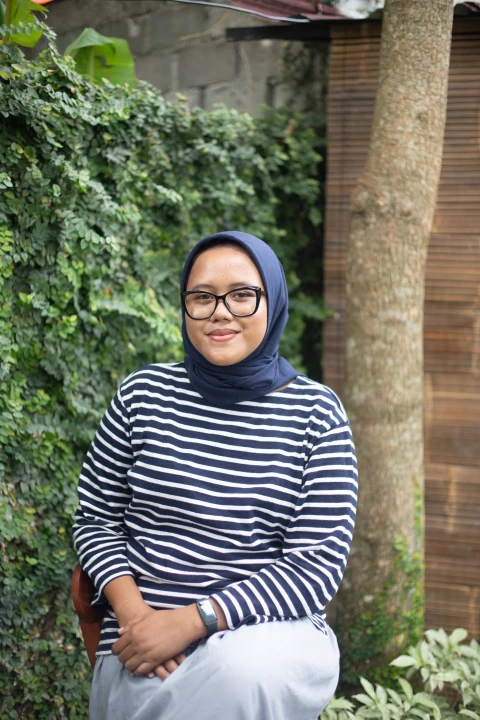
Based in Bali, Indonesia, Gatari Surya Kusuma is a researcher and curator whose practice weaves together art, ecology, and pedagogy. Through action-based and ethnographic research, she explores questions of food sovereignty, cultural continuity, and local resilience. As a 2024 recipient of the Seed Award, supported by Ing Yoe Tan Fund—a legacy name Fund of the visionary parliamentarian and women’s rights advocate Ing Yoe Tan who championed culture, diversity, and empowerment—Gatari continues a legacy of artists committed to community, equity, and sustainability.
All images courtesy of Eri Rama Putra/Seaweet Etcetera.
In the story below, Gatari talks about Bali’s rapidly transforming coastlines—where mega-tourism, privatization, and “green economy” narratives threaten both ecosystems and livelihoods. She turns to art as a practice of care, reciprocity, and attunement. Whether through the curatorial platform "Struggles for Sovereignty" or the artistic research initiative "Seaweed Etcetera", Gatari foregrounds collaboration as a way of sensing and sustaining fragile relations between humans and the more-than-human world.
For readers who may be unfamiliar with the ongoing exploitation of the coastal areas, ocean, and land under the weight of mega-tourism development in the context you live and create in, could you maybe give us a brief introduction?
In Bali and many other coastal areas of Indonesia, the ocean and land have long been treated not as living ecosystems, but as commodities for tourism and real estate speculation. Over the past few decades, mega-tourism development has rapidly transformed coastlines such as reclaiming mangrove forests, privatizing beaches, and displacing small-scale fishing and seaweed-farming communities. Sacred coastal zones that once served as sites of ritual and everyday livelihood are now enclosed by luxury resorts and villas, cutting off access for local people and altering fragile marine ecosystems.
At the same time, the Indonesian government’s response to the climate crisis has been largely performative. While global commitments and “green economy” narratives are frequently used in national branding, little has been done to mitigate the real impacts of rising sea levels, coral bleaching, and intensified coastal erosion. Policies often prioritize foreign investment and tourism infrastructure over ecological regeneration and community resilience.
This exploitation is often justified in the name of “economic growth” or “sustainable tourism,” yet in practice it concentrates wealth while eroding ecological resilience and cultural continuity. For artists and communities working here, these pressures create both urgency and responsibility as to imagine and practice other forms of living with the sea that are rooted in care, reciprocity, and local knowledge rather than extraction.
In previous lectures and interviews, you describe your camera as more than a recording device — as a tool for sensing, listening, and feeling. How do you practically cultivate this sensitivity when working with communities and landscapes in crisis?
For me, the camera is not only a visual instrument but a way of being present. When I work with communities and landscapes affected by ecological and social crises, I try to move away from the extractive impulse of documentation as the idea that taking an image is equivalent to knowing. Instead, I approach the camera as something porous, as a medium that can listen, wait, and attune itself to what is already there.
Practically, this means slowing down. I spend time without photographing, learning the rhythms of a place such as how the tide moves, how people relate to the shoreline, what stories are carried in everyday gestures. The process often involves shared walks, collective listening, or simply being silent together. Only when trust and rhythm emerge does the act of photographing take place. In this sense, photography becomes a critical practice of co-presence rather than documentation. The image emerges from a network of relations, human and more-than-human that conditions its possibility.
This approach challenges the idea of the camera as a detached witness and instead reimagines it as a medium of care and accountability, capable of holding the fragility and resilience of places undergoing transformation. When I speak of holding fragility and resilience, I refer to an ethical stance of staying with the instability of a place without trying to resolve it. Fragility reveals the vulnerabilities of ecosystems and communities under pressure, while resilience speaks to their capacity to adapt and imagine continuity.
The task of the camera, then, is not to aestheticize either condition but to hold space for both to register their entanglement without domination or closure.
In practice, this might mean photographing through collaborative encounters, where the act of making an image becomes an extension of shared attention and care. The camera becomes a witness that is accountable, one that does not claim ownership but participates in the fragile processes of repair and remembering.

Do you believe that art in and of itself has the power to transform societies and influence change?
I am cautious about the idea that art, by itself, can transform societies. Art has symbolic power, it can shift perception, create spaces of reflection, and make visible what is often ignored. But real transformation requires structural change, which emerges from collective movements, policy shifts, and material practices of care.
What art can do, however, is prepare the ground for such transformations. It can cultivate new sensibilities and languages for perceiving the world, especially in contexts where dominant narratives normalize exploitation or inequality.
In my own practice, I see art as a way to build relations: between humans and the more-than-human, between communities and their environments, between knowledge and experience.
So, rather than thinking of art as an isolated force of change, I understand it as part of a larger ecology of practice which is one that can open affective and epistemic possibilities, supporting the slow and often fragile processes through which societies learn to imagine otherwise.
Development projects often measure progress in purely economic terms, while you emphasize memory, belonging, and cultural continuity. What role do you believe artists and curators can play in reshaping these narratives of “progress”?
The dominant narrative of development equates progress with economic growth and infrastructure expansion as a logic that often erases local memory, ecological interdependence, and forms of life that do not fit capitalist temporality. In places like Indonesia, this has meant the transformation of coastal and rural landscapes into “productive assets”, often at the cost of displacement, ecological degradation, and the loss of collective knowledge.
Artists and curators can intervene by creating spaces where other temporalities and values can be felt and thought of. Through collaborative and situated practices, they can foreground memory, belonging, and the continuity of local cosmologies as forms of resistance to linear models of progress.
Art can hold the stories and sensibilities that economic indicators cannot measure; it can trace how people maintain relationships with land and sea, even under conditions of disruption.
Rather than offering solutions, the role of artists and curators is to reframe what counts as meaningful change: to make visible the fragile yet enduring infrastructures of care that sustain life beyond the metrics of growth. In this sense, we participate not in development as extraction, but in the ongoing work of reimagining how we live, remember, and coexist.

In what ways do you believe grants, such as the Seed Award, help artists continue the urgent work within their local contexts and communities?
Grants such as the Seed Award are vital not only for providing material support but for acknowledging the forms of artistic labour that are often invisible within dominant art economies. Many artists working within local and ecological contexts engage in slow, community-based processes such as building trust, learning across differences, and sustaining relationships that don’t fit into fast cycles of production and visibility. Such work rarely generates immediate “outputs”, yet it carries an urgency that is both social and environmental.
Support like the Seed Award enables artists to stay embedded in these contexts and to continue listening, researching, and experimenting without being forced into extractive or market-driven models of practice. Equally important, it affirms that care, collaboration, and place-based knowledge are not peripheral to contemporary art but central to its future.
In this sense, the Seed Award functions less as a reward for individual achievement and more as an act of solidarity, one that helps sustain the fragile ecosystems of practice where art and life are deeply intertwined.

Photography is often seen as a way of capturing the present, but I wonder — what can it do for our future? In your view, how might photography help us imagine or shape the futures we want, and what form do you see that future taking in your own practice?
Photography is often associated with preservation as a means of fixing the present before it disappears. But I’m interested in how photography can instead become a practice of futuring: a way of rehearsing the kinds of relations and sensitivities we want to carry forward.
For me, this begins with rethinking what an image does. An image is never only about the past; it gathers traces, voices, and possibilities that continue to act in the present. When made with care and reciprocity, photographs can help sustain memories that resist erasure not as nostalgia, but as living materials that orient us toward alternative futures.
In my practice, especially through my research collaborative project Seaweed Etcetera, I am working with a photography artist, Eri Rama Putra, and we put photography into a space of relation rather than representation. Working with coastal communities and ecosystems, I see the act of photographing as part of an ongoing dialogue between humans, the sea, and the more-than-human. The future I imagine is not a distant horizon, but a continuous process of learning to live together differently, through attention, care, and mutual responsibility.