A story by Lucrezia
In a country where queer existence is often met with silence, repression, or outright hostility, art becomes both sanctuary and defiance. In this intimate and powerful interview, Georgian artist and 2023 Seed Awardee, Lucrezia, speaks with Val Dechev (Prince Claus Fund's Communications Coordinator) on reclaiming erased histories, using multidisciplinary art as a form of resistance, and the fragile hope of creating a future where queer lives are seen, remembered, and celebrated. Through performance, music, and photography, she challenges the systems that seek to erase them—and in doing so, build a world on their own terms.
For readers who may be unfamiliar with queer rights or the erasure of queer history in Georgia, could you briefly explain the context?
In Georgia, queer people exist in a paradox—always present, always erased. Our stories have been buried under silence, criminalisation, and shame, especially under Soviet rule and the conservative systems that followed. Today, visibility still comes with risk.
In recent years, we have witnessed a painful regression. Hard-won spaces of queer visibility are being violently shut down. The far right and state-aligned forces are working hand in hand to criminalize not just queer life, but even the memory of it. Drag is demonized, Pride is forbidden. The state no longer hides its disdain; it performs it. Many members of our community are forced to flee, exiled not just by violence, but by silence.

You've been exploring queer history as a source of power. How can reclaiming the past serve as queer resistance and resilience?
Revisiting history allows us to reclaim what was stolen.
Queer resistance starts with saying: we were always here. By uncovering hidden narratives, I find strength not only for myself, but for others like me.
It’s a way of refusing erasure and building a sense of lineage, of belonging, in a world that often denies us both.
Do you believe that art in and of itself has the power to transform societies and influence change?
Yes—art opens emotional spaces that politics often can’t reach. It creates intimacy, reflection, and empathy. In places where speaking freely is dangerous, art becomes a safe but radical tool. It can unsettle, awaken, and even heal; sometimes quietly, sometimes like a scream.


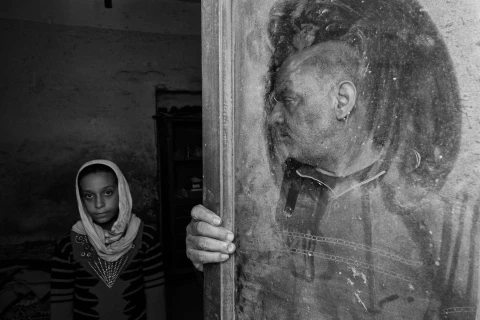
Art is political even when it doesn’t speak in slogans. The body on stage, a queer gesture, a soft gaze captured in a photograph—all of it resists erasure. In a system built on silence and shame, to tell a different story, to exist visibly and vulnerably, is a political act.
Art doesn’t just reflect change, it imagines it, rehearses it, and sometimes even brings it closer.
You work across performance, music, and photography. Is this multidisciplinary approach a deliberate choice? How do these mediums interact to shape the world you’re creating?
It’s an intuitive choice, but also deeply personal. Each medium holds a different part of me like different languages for the same longing.
Performance is where I become spirit and flesh at once. It allows me to shed and shape identities in real time. It’s a ritual, a confrontation, a way to reclaim the body that the world so often politicizes or hides. Music runs in my blood. I come from a family of musicians. Sound is how I first learned to feel, to grieve, to remember. It holds things I can’t say in words. Through music, I connect to my grandmother, to ancestors I never met, to parts of myself I am still becoming. Photography, for me, is about stillness and myth-making. It freezes moments of intimacy and softness that might otherwise be lost. I often use it to construct icons, fragments of queer memory, or alternate histories that never had the chance to exist.
Together, these mediums don’t compete, they complete. They help me build a world where binaries collapse, where pain becomes poetry, and where my story can be told on my own terms.

What has been the public’s reaction to your recent work? Is there a reaction you usually aim and hope for?
Reactions vary; some feel deeply moved, others disturbed. In Georgia, queerness in art often provokes discomfort, even hatred. I’ve received threats, been ridiculed online, had my body and identity reduced to memes and insults. The violence is not always physical but it’s persistent, especially in digital spaces. And still, I don’t seek approval. I want to make people feel tenderness, discomfort, curiosity, even shame. I want them to confront their own gaze. To ask: Why does this image provoke me? Why does this softness threaten me?
If someone walks away questioning what they thought they knew about gender, about history, about whose bodies are allowed to be sacred, then the work is alive. Then I know it reached somewhere deeper than language.
In what ways do grants, such as the Seed Award, help artists where expression is suppressed?
Receiving the Seed Award was like being told: you matter. In a country that erases voices like mine, the support allowed me to create freely without fear, without apology. It gave me time, space, and the courage to imagine more.
Before the Award, it was hard for me to explore new mediums. Working across disciplines requires materials, tools, access, and for queer artists in Georgia, those resources are often out of reach. Queer art is rarely institutionally supported. It lives in the underground, where it’s vital but often invisible, underfunded, and undervalued.
The Seed Award gave me wings. It allowed me to experiment, to move beyond what I already knew, and to say more, to create more.
It reminded me that my voice isn’t just about surviving in the margins. It can take up space. It can build worlds.


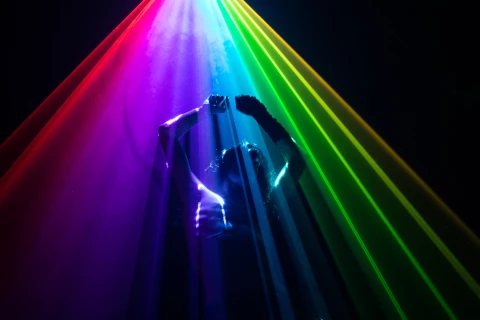
Your performance work “Silver lining” evokes a statuesque but also religious imagery, while presenting your body as draped and nearly invisible. Can you tell us more about the piece and the choice for the draping?
Indeed, the piece plays with visibility and reverence. Draping became a metaphor for protection, for ritual, for absence. Invisibility, for queer people, is often survival. But in “Silver lining”, I turned it into a quiet superpower. A way to reclaim softness, holiness, and control over how I am seen.
The transparency in the piece speaks to queer visibility; how we are often seen through, but not truly seen. It was also an offering to all the queer people who don’t have the space or safety to speak out. Through this performance, I wanted to give voice to their silence. The poem embedded in the work was written as a kind of invocation; a wake-up call, a plea for people to see what has been made invisible. To feel the sacredness in queer existence.
I used traditional Georgian instruments and earth itself and soil as sound and presence. Earth is origin and memory. It connects the ritual to land, to ancestry, to the beginning of everything. Through that grounding, I tried to weave queerness back into a place it has always belonged to, even if it’s been denied.

What does the future look like to you?
Honestly, sometimes I’m scared of the future. I don’t know where I’ll be. I don’t know if I’ll still have space to create, to speak, to exist safely in the place I call home. Support has been cut. Repression is growing. Every day it feels like the walls are closing in a bit more for queer people in Georgia.
I try to hold on to hope, but it’s fragile.
Still, I believe in the invisible threads that bind us. I believe that even in exile, even in fear, we can carry the future with us in our bodies, in our art, in each other.
But lately, it feels like the future is slipping through our fingers. Like we are screaming into a void that has already made up its mind. And some days, I wonder if anyone is still listening.